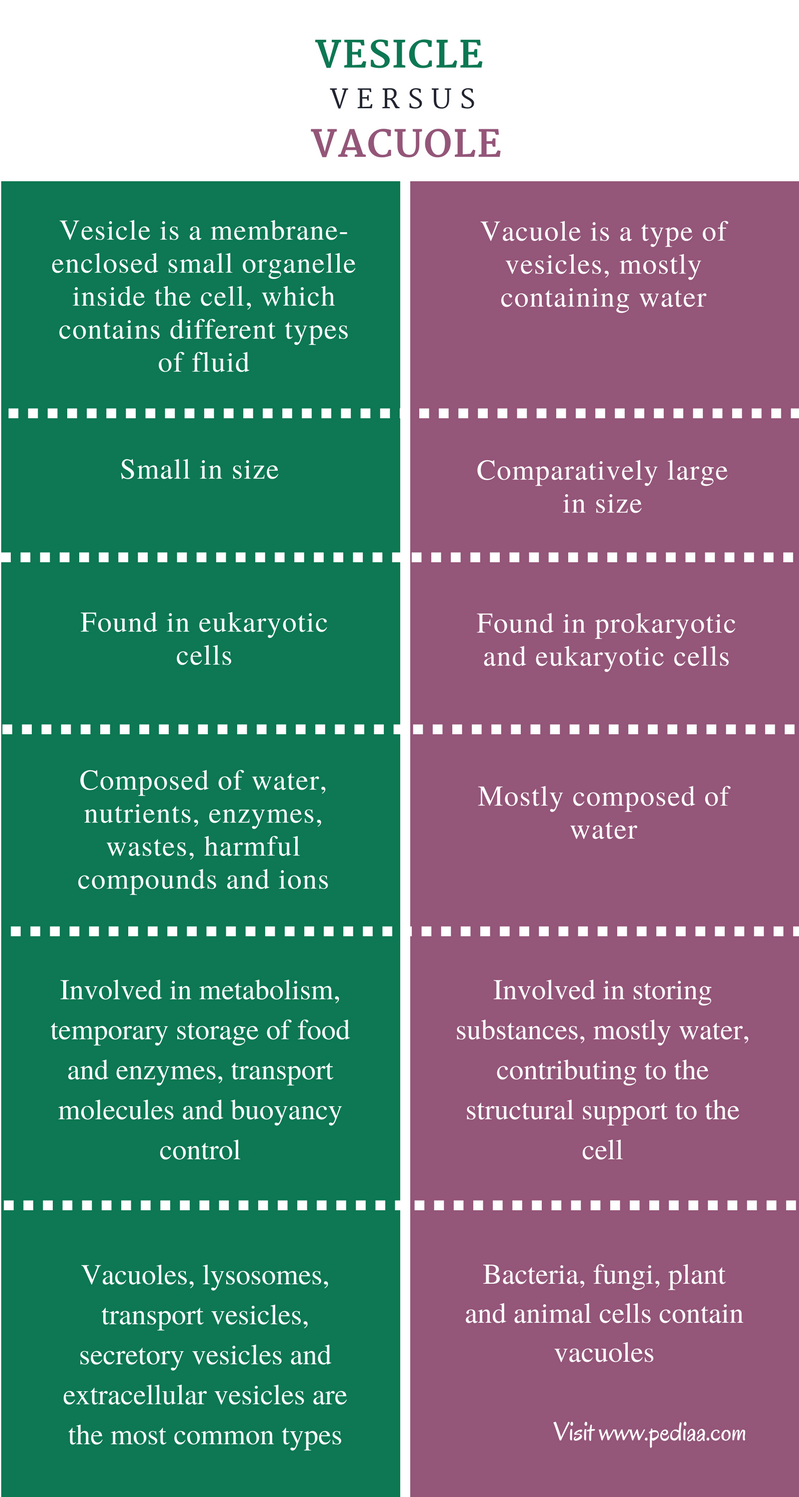
In Which Way Are Vesicles Different From Vacuoles . Animal cell vacuoles are typically small, and each cell can contain multiple vacuoles. Difference between vesicles and vacuoles.
What Is The Difference Between A Vesicle And A Vacuole? - Quora from www.quora.com
Multiple membrane vesicles come together to form vacuoles; Vacuoles stores the undigested nutrients while the lysosomes are the membrane bound sacs containing digestive enzymes that breaks down large molecules.
What Is The Difference Between A Vesicle And A Vacuole? - Quora
The difference would be due to its contents and its construction. Vesicles are the structures in cells. On the flip side, the vacuole mainly made up of water.
Source: openoregon.pressbooks.pub
The main difference between vesicles and vacuole is that vesicle is designed to store different types of molecules whereas vacuole is a type of vesicle, mostly storing water. On the contrary, the vacuole is present in both prokaryotic and eukaryotic cells. In a way, they're specialized lysosomes.
Source: qrbiology.weebly.com
A vacuole is larger, a membrane bound organelle, present in plant and fungal cells. Complete step by step answer: Vacuoles are membrane bound enclosed compartments which are rich in different types of organic and inorganic molecules including enzymes and pigments and other metabolic products.
Source: prezi.com
There are two different types of contractile vacuoles. That is to say that their function is really to handle waste products, and by handle, mean take in waste products and also get rid of waste products. This type of vesicle is especially important in.
Source: openoregon.pressbooks.pub
A vacuole is larger, a membrane bound organelle, present in plant and fungal cells. The vesicles moved exclusively from the. A vesicle is present in all eukaryotic cells;
Source: openoregon.pressbooks.pub
Movement of membrane proteins within the secretory pathway of plant cells is complex because plant cells may contain different types of vacuoles ( hoh et al., 1995;paris et al., 1996;di. The difference would be due to its contents and its construction. The vacuole is a membrane bound organelle present in both prokaryotic and eukaryotic cells.
Source: pediaa.com
Sometimes the waste product is water, and therefore a vacuole would. That is to say that their function is really to handle waste products, and by handle, mean take in waste products and also get rid of waste products. Movement of membrane proteins within the secretory pathway of plant cells is complex because plant cells may contain different types of.
Source: www.quora.com
Which way will water move? In short, if there is too much water in the cell, it will rupture, so the contractile vacuole is crucial to the survival of the paramecium. The membrane holds fluid called cell sap, which is composed of water and other substances.
Source: en.wikipedia.org
Animal cells do have vacuoles, but they are smaller, larger in number (plant cells usually have just one or a few large vacuoles) and serve a somewhat different purpose than those of plants. The nuclear membrane differs from the plasma membrane in that the nuclear membrane is a single layer of phospholipids. Vacuoles are home to enzymes, which play an.
Source: www.differencebetween.com
On the contrary, the vacuole is present in both prokaryotic and eukaryotic cells. The golgi apparatus modifies, sorts, and packages different substances for secretion out of the cell, or for use within the cell. In a way, they're specialized lysosomes.
Source: www.ck12.org
Which is why they are larger than other cell organelles. The membrane holds fluid called cell sap, which is composed of water and other substances. The components of the vacuole, known as the cell sap, differ from that of the surrounding cytoplasm.
Source: www.differencebetween.com
Animal cell vacuoles are typically small, and each cell can contain multiple vacuoles. Pushes the plasma membrane against the cell wall of plant; The vacuole is a membrane bound organelle present in both prokaryotic and eukaryotic cells.
Source: www.quora.com
Pushes the plasma membrane against the cell wall of plant; Vacuoles are membrane bound enclosed compartments which are rich in different types of organic and inorganic molecules including enzymes and pigments and other metabolic products. Larger and store excess substances.
Source: www.differencebetween.com
The vesicles are moved along the microtubules in a cell by motor proteins, like dynein and kinesin. The difference would be due to its contents and its construction. Vacuole, in biology, a space within a cell that is empty of.
Source: slideplayer.com
The golgi apparatus is found close to the nucleus of the cell, where it modifies proteins that have been delivered in. The membrane holds fluid called cell sap, which is composed of water and other substances. This type of vesicle is especially important in.
Source: pediaa.com
Difference between vesicles and vacuoles. They contain a solution of mineral salts, sugars, amino acids,waste products and sometimes pigments. It is constantly working to regulate this balance.
Source: www.quora.com
A plant cell has a prominent vacuole while animal cells contain small vacuoles. This type of vesicle is especially important in. The components of the vacuole, known as the cell sap, differ from that of the surrounding cytoplasm.
Source: study.com
The nuclear membrane differs from the plasma membrane in that the nuclear membrane is a single layer of phospholipids. Both lysosomes and vacuoles are endomembrane structures, but the vast difference is seen in their function. Vacuoles are filled with water, excretory substances, pigments, wastes, etc.
Source: twitter.com
Both lysosomes and vacuoles are endomembrane structures, but the vast difference is seen in their function. Multiple membrane vesicles come together to form vacuoles; They contain a solution of mineral salts, sugars, amino acids,waste products and sometimes pigments.
Source: www.ck12.org
Pushes the plasma membrane against the cell wall of plant; The golgi apparatus is found close to the nucleus of the cell, where it modifies proteins that have been delivered in. A plant cell has a prominent vacuole while animal cells contain small vacuoles.
Source: slideplayer.com
Apart from water, vacuoles also contains different kinds of organic/inorganic molecules, solid materials and enzymes. The golgi apparatus is found close to the nucleus of the cell, where it modifies proteins that have been delivered in. Vacuoles are membrane bound enclosed compartments which are rich in different types of organic and inorganic molecules including enzymes and pigments and other metabolic.