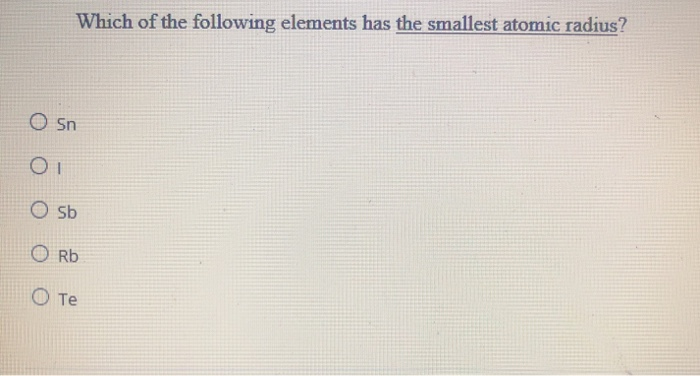
Which Element Has The Smallest Radius . The concentration of more protons in the nucleus creates a higher effective nuclear charge, in other words, there is a stronger force of attraction pulling the electrons closer to the nucleus resulting in a smaller atomic radius. The first ionization energy of sulfur is less than that of a phosphorus.
Solved Which Of The Following Elements Has The Smallest | Chegg.com from www.chegg.com
Periodic table of elements with covalent radius trends. Which one of the following elements has the largest atomic.
Solved Which Of The Following Elements Has The Smallest | Chegg.com
Atomic radius decreases as you move across a period from left to right and decreases as you move up a group from bottom to top. Therefore sodium (na) has the largest atomic radius. No of l u = 7 1, l a = 5 7 )?
Source: www.chegg.com
This is due to trends in the periodic table, and the effective nuclear charge that holds the valence electrons close to the nucleus. Magnesium has a smaller atomic radius because it has 2 valence electrons. Helium has the smallest atomic radius.
Source: www.numerade.com
119 rows we have shown the atomic radius of the elements for which reliable. Which element of period 3 has the largest radius? Which one of the following atoms has the largest radius?
Source: utedzz.blogspot.com
The concentration of more protons in the nucleus creates a higher effective nuclear charge, in other words, there is a stronger force of attraction pulling the electrons closer to the nucleus resulting in a smaller atomic radius. Strontium has a larger atomic radius because strontium has more shells of electrons than magnesium does. Helium has the smallest atomic radius.
Source: socratic.org
Which one of the following atoms has the largest radius? Which element has the smallest radius? An old problem, and one that which the periodic table, which should be routinely available in all chemistry and fyziks examinations (and which should be in front of you now!), directly addresses.
Source: www.youtube.com
Helium has the smallest atomic radius. Thus, helium is the smallest element, and francium is the largest. Which element has the smallest radius?
Source: socratic.org
Therefore sodium (na) has the largest atomic radius. Which one of the following elements has the largest atomic. A reasonable explanation for this fact involves.
Source: www.angelo.edu
Which of the lists of increasing ionic radii is not correct? Atomic size gradually decreases from left to. In the below periodic table you can see the trend of covalent radius.
Source: chemistrytalk.org
Lithiumso, for period 2, the group1 alkali metal (lithium, lowest z) has the largest atomic radius and the group 7/17 halogens & group 0/18 noble gas (fluorine & neon, highest z’s) have the smallest atomic radii (there is some uncertainty in the noble gas radii). Which elements have the smallest radius? For facts, physical properties, chemical properties, structure and atomic.
Source: www.chegg.com
119 rows elements atomic radius of elements (pm) 1: Therefore sodium (na) has the largest atomic radius. Atomic size gradually decreases from left to.
Source: www.clutchprep.com
This is done by beaming a signal of a certain frequency through isolated cesium atoms. So this makes the task simple. Because of these two trends, the largest atoms are found in the lower left corner of the periodic table, and the smallest are found in the upper right.
Source: sciencenotes.org
Therefore sodium (na) has the largest atomic radius. Strontium has a larger atomic radius because strontium has more shells of electrons than magnesium does. In context of the lanthanoids , which of the following statements is not correct ?
Source: blog.prepscholar.com
Franciumatomic radii vary in a predictable way across the periodic table. What causes the atomic radius of the elements to decrease across period 3 from left to right? Which elements have the smallest radius?
Source: brainly.com
This is done by beaming a signal of a certain frequency through isolated cesium atoms. No of l u = 7 1, l a = 5 7 )? As can be seen in the figures below, the atomic radius increases from top to bottom in a group, and decreases from left to right across a period.
Source: www.breakingatom.com
Cesium is used to calculate the length of a second. What causes the atomic radius of the elements to decrease across period 3 from left to right? So, all these elements belong to the 4th group and kr has the smallest atomic radii as it lies across the period.
Source: www.ck12.org
Helium has the smallest atomic radius. Cesium is used to calculate the length of a second. Oct 11, 2017 · the element that has the smallest atomic radius is fluorine.
Source: www.chegg.com
A) na b) cl c) p d) br e) k. So, all these elements belong to the 4th group and kr has the smallest atomic radii as it lies across the period. A) se b) as c) s d) sb e) te.
Source: www.quora.com
Atomic radii vary in a predictable way across the periodic table. An atom of which of the following elements has the smallest atomic radius? A reasonable explanation for this fact involves.
Source: www.clutchprep.com
Which one of the following has the smallest radius? Because of these two trends, the largest atoms are found in the lower left corner of the periodic table, and the smallest are found in the upper right. Which elements have the smallest radius?
Source: slideplayer.com
Because of these two trends, the largest atoms are found in the lower left corner of the periodic table, and the smallest are found in the upper right. No of l u = 7 1, l a = 5 7 )? Oct 11, 2017 · the element that has the smallest atomic radius is fluorine.
Source: physicalsciencetext.weebly.com
Which one of the following elements has the largest atomic. It not only tells you names of elements a, b, c, d but also their groups and periods. Atomic radius can be defined as a property of elements in the periodic table which is the measure of the distance between the nuclei of two identical atoms bonded together.